At Mobile World Congress in Barcelona this week, PacketVideo is demonstrating a mobile broadcast TV add-on receiver which enables TV playback on any mobile device with WiFi capabilities. The device will be available in different versions for DVB-H, MediaFLO and WiMax, and is compatible with Nokia N-series, Apple iPhone and HTC Smartphone devices.
S3 showed a similar add-on device by Nokia, which receives DVB-H and sends it to compatible mobile phones over Bluetooth. S3 is providing the DVB-H protocol stack for the Nokia N810 Internet tablet which supports the add-on accessory device.
Showing posts with label devices. Show all posts
Showing posts with label devices. Show all posts
Thursday, February 14, 2008


Thursday, May 31, 2007
Motorola's MediaFLO Mobile TV Handset

According to PhoneScoop, the FCC has revealed the Motorola Z6tv phone which supports Qualcomm's MediaFLO mobile broadcast TV technology, and Verizon's VCast Mobile TV service. The phone has not been announced by Motorola yet, and has been revealed through the FCC approval process for the US market.
According to the FCC webiste, the phone also has EV-DO high-speed cellular data support, a 2 megapixel camera and USB connectivity. This is the first Motorola phone outside of Korea that supports mobile broadcast TV. Previously Motorola announced a Satellite DMB phone called "Moto View" for the Korean market.
Thursday, February 15, 2007
3GSM 2007 Mobile TV Highlights
As expected, 3GSM 2007 was packed with Mobile TV demonstrations everywhere - including handsets, chipsets, network infrastructure, enabling technologies and content.
On the handset side, the show's major announcement was probably the Nokia N77 DVB-H handset. As rumored just before the show, this is a mid-range handset, which is targeted at initial DVB-H deployments in Vietnam, Italy and Finland. I took a look at the video quality, and it was quite good at 15 frames per second. However, every minute or two there was an occasional error in the stream (picture freezes or breaks into blocks). The demonstrator at the N77 stand in the Nokia booth claimed that this was due to the "crowded network at the show", which seems highly unlikely since DVB-H is a broadcast network... The channel switching time was also quite long, at 4-6 seconds. The long switching time was also apparent in other DVB-H demos at the show, and I also noticed this issue in CES demos last month, which leads to the conclusion that this is probably an inherent issue with current DVB-H implementations. The Nokia representative told me that the handset will cost 370 Euros without subsidies, and has a 5 hour TV viewing time, and 7.5 days standby time.
Another DVB-H handset was demonstrated by Sagem. Sagem is not a top-tier mobile handset vendor, but their myMobileTV handset is very nicely designed, and features an innovative auto-rotate feature which rotates and expands the image based on the direction in which the device is being held, using an acceleration sensor. In this demo I also witnessed the long channel switching time, and the occasional frame error every 1-2 minutes. The Sagem demonstrator came up with another original excuse for this, claiming that it was due to a low battery on the device (although the device was connected to a power supply and charging...). Another interesting handset demonstrated at the show was the Samsung SGH-F510, a slim DVB-H phone which blends well with the company's "thin is in" design.
Qualcomm showed the MediaFLO handsets which will launch with Verizon's service at the end of this quarter, the Samsung SCH-U620 and the LG VX9400. Qualcomm also showed a prototype handset of its own design, which is used mainly for testing the service. Judging by the video quality, it seems that MediaFLO currently has the edge: Frame rate is about 20-25 frames per second, and channel switching time is 2 seconds. MediaFLO also had a larger variety of channels at the show: 20 TV channels vs. only 9 channels which were available on the SIDSA DVB-H demo network at the show.
Other vendors were showing unicast live TV over cellular networks, circuit-switched streaming (using 3G video telephony for content delivery), and TV interactivity solutions. Compared to last year's show, 3GSM 2007 demonstrated the maturity of mobile TV technology and the range of available handsets, driven by commercially deployed services. However, subscriber numbers for paid mobile broadcast TV services in Europe remain low, both for DVB-H and for DAB-IP, so the question of return on investment still remains.
Sunday, February 11, 2007
3GSM 2007 Mobile TV Preview
The industry is preparing for this year's 3GSM conference in Barcelona, which will take place from Monday 12/2 until Thursday 15/2. According to a poll by EETimes Europe, mobile TV will be the key topic at 3GSM this year, and indeed several companies are preparing to showcase their mobile TV products at the show. These demonstrations will be assisted by a 3GSM DVB-H network operated by Spanish mobile TV technology provider SISDA and local operator Albertis telecom. The network will broadcast 10 mobile TV channels, including MTV, CNBC, CNN and some Spanish TV channels. One of the channels will be 3GSM TV, which broadcasts live news and content directly from the show.
Some of the other demonstrations at the show:
* According to sources quoted by Reuters, Nokia is planning to reveal a mid-range N-Series mobile phone called N77, capable of receiving DVB-H broadcasts. The phone is supposed to be in the 200-300 Euro range, as opposed to Nokia's N-92 DVB-H handset which currently costs over 600 Euros.
* Chinese handset vendor ZTE will demonstrate its own "N-Series" DVB-H mobile phone, the N7100, which is based on Siano's SMS1000 mobile TV receiver chipset. The N7100 handset, which features HSDPA high-speed cellular connectivity, will be distributed in Italy by Telecom Italia Mobile in the next few weeks.
* Mobile TV chip vendor Frontier Silicon and mobile TV software vendor S3 will demonstrate a multi-mode reference design for mobile TV based on Frontier Silicon's FS1030 "Paradiso" moible TV receiver which supports DVB-H, DVB-T, T-DMB and DAB-IP; and on S3's "onHandTV" multi-standard mobile TV client software.
* NEC and Telegent systems will demonstrate a high-definition, low-power mobile TV platform running on NEC's application processor, which allows up to four and a half hours of viewing time.
* TI, Orange and Viaccess will demonsrate content and access protection for mobile TV services, utlizing TI’s M-Shield security framework, which is integrated into the OMAP application processor platform.
* NXP software (formerly Philips Software) will demonstrate a full mobile TV software solution running on TI's OMAPV1030 baseband application processor.
* Ericsson will demonstrate mobile TV using MBMS (Multimedia Broadcast Multicast Service), following a successful MBMS trial conducted in 2006. Ericsson plans commercial rollout of MBMS services in 2008.
I'm off to Barcelona tonight, and will do my best to continue and provide mobile TV coverage from the show itself.
Wednesday, January 10, 2007
CES Mobile TV Highlights - Part 2
I got a closer look at the LG VX9400 today at the MediaFLO booth. The video quality was very good, with no frame drops, and a surprising channel switching time of less than 2 seconds. The phone itself has a nice design, and is not bulky as you might expect from a phone that incorporates an additional receiver. The only issue is the external retractable antenna, which resembles the cellular phones we had 10 years ago. It seems fragile and looks completely out of place - hopefully newer models will feature an internal antenna.
I also saw the Samsung SCH-U620 MediaFLO phone at the Samsung booth. At first, it seemed that quality is much worse - frequent frame drops, and a channel switching time of 4-6 seconds. But, when I moved the handset a few meters to another location, the reception improved significantly, and I witnesses similar reception quality to the LG phone. The Samsung handset is also very nicely designed, althugh the screen doesn't rotate 90 degrees as with the LG model, and there is still the issue of the external retractable antenna.
The Modeo DVB-H phone, designed by HTC, was also demonstrated at the show, both at the Microtune stand in the IBM booth (local playback only), and at the HTC stand in the Microsoft booth (live TV reception). Quality was lower than the MediaFLO service, with frequent frame drops and a channel switching time of 6-8 seconds.
The demo of TV over Wimax, mentioned in my previous post, was shown at the Intel and Samsung booths. The demo shows streaming television at 1 megabits per second, including an integrated TV channel guide. It turned out that the demo, which is implemented using a USB dongle receiver by Samsung, does not use standard WiMax but actually WiBro, the pre-standard version which is deployed in Korea.
IPTV, HD content download from the Internet, home media distribution and wireless HDMI were also major topics at this year's show, but not for this blog...
Tuesday, January 09, 2007
CES Mobile TV Highlights - Part 1
Yes, it's that time of year again, when 140,000 people gather in Las Vegas to see the latest consumer electronic products and services. The major announcement of the first day was the official launch of the MediaFLO Mobile TV service by Verizon in the USA. The printed edition of USA Today which I got at the airport on my way to CES featured this item on the front page. The service will go live at the end of March, with CBS, NBC, Fox, MTV, Comedy Central and Nickelodeon. Verizon will offer phones from Samsung and LG to support the service.
I saw the LG 9400 MediaFLO phone at LG's booth today, and TV reception quality is very good. You can see pictures of the phone at gearlog. LG also had a DVB-H phone at their booth, but it wasn't receiving any TV signals...
Modeo, which plans to launch a competing mobile TV service in the USA using DVB-H technology, announced its "commercial quality mobile TV beta service", which will start in the first quarter of 2007 in New York. Modeo's service will feature TV content from FOX and The Discovery Channel, and radio content from Music Choice. The choice of handsets, however, will be limited to a single handset designed by HTC.
As if we didn't have enough mobile broadcast TV standards, Samsung announced its own mobile TV technology which is being trialed this week at CES. The technology, called Advanced-VSB (or A-VSB for short), is an enhancement of the existing VSB digital television standard used by ATSC, and enables broadcasters to transmit a mobile digital TV signal on the same frequency as they use for standard television broadcasting. And another emerging bearer for mobile TV is WiMax: MobiTV, NDS and RunCom are demonstrating mobile TV over WiMax at the show.
More on Mobile TV at CES tomorrow...
Thursday, November 23, 2006
Samsung SGH-P930: New DVB-H Handset for the Italian Market
Cellular News reports that Samsung has released a new mobile TV handset named SGH-P930, which will be used in the DVB-H service offered by Telecom Italia and Mediaset. The phone includes HSDPA cellular connectivity, a 2.3 inch LCD display with a resolution of 240x320 pixels, and it supports Picture in Picture (PIP) for viewing two mobile TV channels simultaneously.
Friday, November 17, 2006
Verizon and Sprint MediaFLO Services Powered by Samsung Handsets
Engadget has spotted two Samsung handsets which will be used in commercial MediaFLO mobile TV services in the US. The Samsung U620 will be used for Verizon's VCAST mobile TV service, while the Samsung M250 is already powering Sprint's trial of the competing VUE mobile TV service in Kansas City and Las Vegas.
Thursday, November 16, 2006
SlingMedia Available on 3 UK Phones
SlingMedia, which developed the Slingbox device for broadcasting TV content from the user's home over the Internet, announced a partnership with 3 UK which will enable subscribers to watch their own TV channels from home on their cellular phones. The service will be available to customers who purchase both an X-series handset (either the Nokia N73 or the Sony Ericsson W950i) and a Slingbox. The service is unique in that it offers the first implementation of the SlingPlayer on a non-Windows platform, and is currently exclusive to 3 UK X-series customers.
The announcement did not mention specific pricing for the service, but the offical press release states that all X-services will be available for a fixed fee on top of the basic subscribtion fee, and that additional access fees will be charged the Sling service. It is interesting to note that owners of Windows Mobile smartphones and PDAs can purchase the SlingPlayer application and enjoy the service for free (excluding 3G data charges), regardless of their wireless carrier. This could become a threat to paid cellular TV services, and to mobile broadcast TV services as well: If users can watch their own favorite TV channels from home on their cellular phones, why would they subscribe to a paid service that provides the same content?
The announcement did not mention specific pricing for the service, but the offical press release states that all X-services will be available for a fixed fee on top of the basic subscribtion fee, and that additional access fees will be charged the Sling service. It is interesting to note that owners of Windows Mobile smartphones and PDAs can purchase the SlingPlayer application and enjoy the service for free (excluding 3G data charges), regardless of their wireless carrier. This could become a threat to paid cellular TV services, and to mobile broadcast TV services as well: If users can watch their own favorite TV channels from home on their cellular phones, why would they subscribe to a paid service that provides the same content?
Tuesday, October 24, 2006
New Mobile TV Handsets
According to a new report by ABI Research, penetration of mobile TV handsets in Japan and Korea is increasing, with over 14% of Korean handsets already supporting mobile broadcast TV. In the past two weeks, we have witnessed a flood of mobile TV device announcements originating in South East Asia. Here are some examples:
- LG launched a slim mobile TV phone, less than 11 mm thick.
- Samsung announced two "ultra-slim" mobile TV handsets, the SCH-B510 which supports S-DMB and the SPH-B5100 which supports T-DMB.
- Samsung also announced the SCH-B560, a rotating-screen T-DMB handset.
- The SCH-B600, Samsung's new 10-Megapixel camera phone, includes an S-DMB receiver.
- Motorola announced a satellite DMB phone for the Korean market called "Moto View".
- Taiwanese handset vendor Gigabyte announced the GSmart i200 handset, a DVB-H device running Windows Mobile 5.0, and featuring a VGA display. The handset includes a mobile TV receiver chip by Siano Mobile Silicon, and DVB-H client software by Panthera.
- Another handset powered by the Siano receiver was unveiled by by Chinese ODM TechFaith Wireless. The handset is a dual-mode mobile TV phone, supporting T-DMB, DAB-IP and DVB-H.
Other recent announcements of mobile TV devices include a navigator and a PDA by LG, and a PMP by Korean vendor Yukyung Technology.
Monday, September 11, 2006
BT Movio and Virgin Mobile Launch DAB-IP Commercial Mobile TV Service in the UK
BT Movio will launch the world's first mobile TV service based on the DAB-IP standard on October 1st, 2006. Virgin Mobile will be the first retail provider of the service, but others are expected to follow. The service will offer 4 TV stations - BBC One, ITV1, Channel 4 and E4, and 30-50 UK DAB radio stations. The service is supported by the Virgin Mobile Lobster 700TV phone (previously code-named "Trilogy"), which is designed and manufactured by HTC. The phone cost £199, and the service cost is £5 a month following a 3-month free trial period.
Wednesday, April 05, 2006
Modeo Demonstrates Custom DVB-H Handset at CTIA Wireless
US mobile TV service provider Modeo is demonstrating its DVB-H technology at CTIA Wireless this week using a Windows Mobile 5.0 Smartphone, which was custom-designed for the company by Taiwanese ODM HTC. The handset includes a TI OMAP 850 integrated baseband/application processor, an NVIDIA Go-Force 5500 multimedia and graphics processor, a DibCom DVB-H demodulator and a Microtune MT220 DVB-H tuner. The handset receives DVB-H broadcasts using the Windows Media Video and Windows Media Audio codecs, and utilizes Microsoft's DRM.
Thursday, March 09, 2006
Mobile TV Device Update
A lot of news coming in on mobile TV handsets in the last few days, mainly due to the CeBIT 2006 exhibition which opens today. EE Times reports that Kitae Lee, president of Samsung Telecommunications, opened CeBIT today with a prediction that the global mobile TV handset market will reach about 6 million units this year, and that Samsung plans to grab 20% of this market.
Samsung is also showing an "Ultra-Mobile PC" (UMPC) device at the show, the type of device that caught the industry's attention in the last few weeks under the code name "Origami". According to a report by Engadget, Samsung's device will have an optional DMB (and eventually DVB-H) expansion module.
LG announced their first commercial T-DMB phone for Europe, which will be released first in Germany during May of this year. The device features a rotating 2.2" LCD screen, and claims a 3 hour battery life while viewing TV broadcasts. Two other mobile TV handsets which will be shown at CeBIT are the Sagem myMobileTV and the BenQ DVB-H phone.
Thursday, February 16, 2006
3GSM 2006 Mobile TV Update - Part 3
To round up our 3-part summary of mobile TV news at 3GSM, Strategy Analytics published a new market research report on the topic of mobile TV, predicting that revenues from TV phone sales will increase form $8B in 2006 to $30B in 2010. The report also forecasts that DVB-H will account for 19% of TV phones in 2006, rising to 40% of the total TV phone market in 2010.
Not only phones will be able to receive mobile TV broadcasts, but portable game consoles as well. In a press conference in Tokyo yesterday, Nintendo said they will offer a mobile TV receiver card for the Nintendo GameBoy DS. The receiver will be available in Japan only, and will support the mobile ISDB-T broadcasts which are scheduled to begin in April.
And back to the good old TV-over-cellular services: Alcatel announced that T-Mobile has selected its technology to provide interactive mobile TV services over EDGE and 3G in the UK, Germany and Austria. Alcatel will be responsible for aggregating the live TV content, producing the mobile-specific channels, and hosting the service platform for all three countries from its centre in Stuttgart, Germany.
Tuesday, February 14, 2006
3GSM 2006 Mobile TV Update - Part 2
The stream of mobile TV announcements at 3GSM 2006 in Barcelona continues, with Nortel announcing its mobile TV solutions over HSDPA, MBMS and DVB-H networks. T-DMB keeps gaining momentum in Europe, with Samsung announcing that it is working with Bouygues Telecom, TF1 and VDL on a T-DMB trial in France that will start at the end of this month. Samsung is not betting on T-DMB alone: At 3GSM, Samsung is demonstrating 7 different Mobile TV handset models, supporting various combinations of T-DMB, S-DMB, DVB-H and MediaFlo. Samsung also surprised the mobile TV chip industry with an Announcement of its own DVB-H front-end solution, comprising of an RF CMOS tuner chip and a DVB-H Channel decoder which also support DVB-T.
While Samsung is a new player in DVB-H chips, DiBcom which is one of the more established players announced a joint reference design with NDS which implements Conditional Access for DVB-H receivers, complaint with the DVB CBMS standard. And still on the mobile TV chip front, Philips introduced the new version of their DVB-H receiver chip, which includes a tuner and a demodulator in a 7x7 mm package.
If we didn't have enough mobile TV standards already, Alcatel is proposing a combination of satellite-based and terrestrial-based DVB-H mobile TV broadcasting in the S-band, which is supposed to enable re-use of existing 3G base stations, and solve the frequency allocation problems of DVB-H in Europe. Interesting concept technically, but pulling together the whole value chain to support it (satellite operators, handset vendors, other network equipment vendors) will be quite difficult.
Stay tuned for more mobile TV news from 3GSM 2006...
Tuesday, February 07, 2006
Samsung T-DMB Phone for Europe
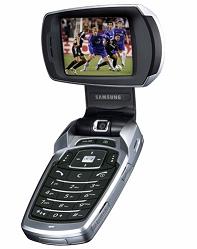
Samsung has announced a T-DMB phone for Europe which will be launched in time for the FIFA world cup in Germany this June. The phone has an Electronic Program Guide (EPG), analog video output (TV out), and a built-in Personal Video Recorder (PVR) for recording mobile TV programs. The phone also features a 2 megapixel camera, MP3 player, Bluetooth and USB connectivity. According to an article published in the Korea Herald yesterday, Samsung will export its T-DMB phone to Germany from April of this year.
Subscribe to:
Posts (Atom)